KRONOS Technology
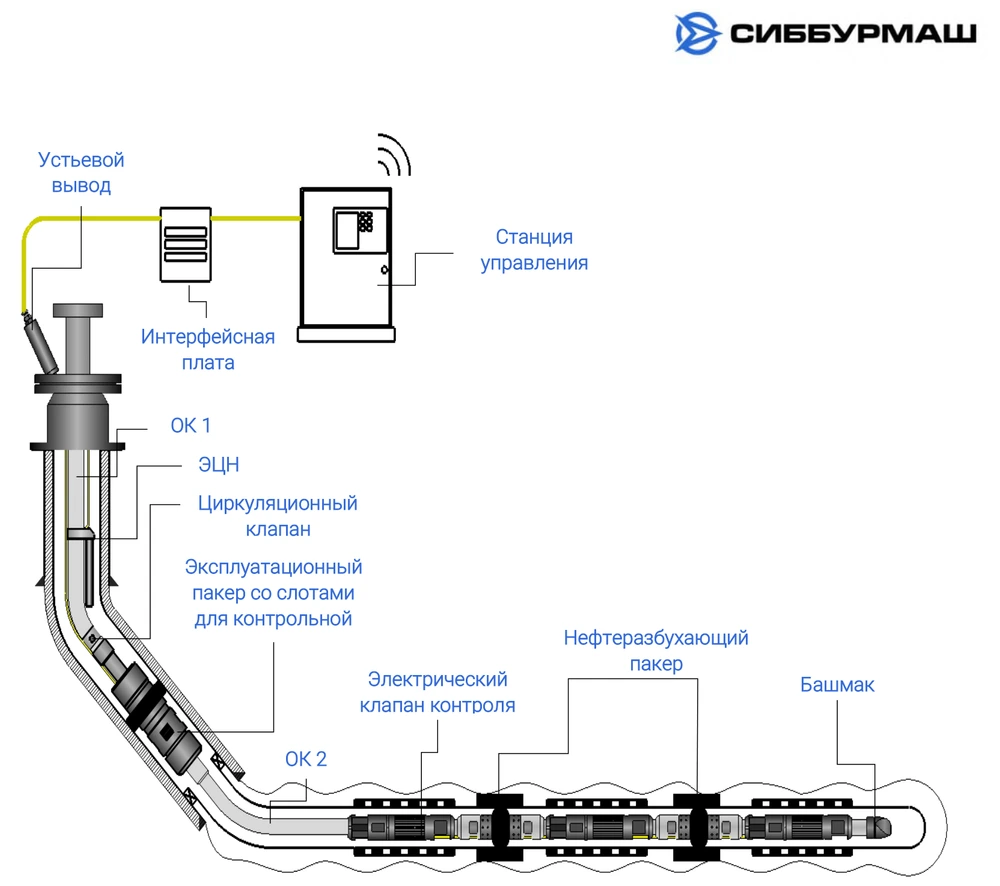
An intelligent well-completion system that enables zone-by-zone control of the well production rate without any additional downhole equipment run-in and without stopping production.
Advantages
- Zone-by-zone control without stopping production. Packers divide the wellbore into segments, and electric valves make it possible to open/close or vary the opening degree of each interval in real time. Meanwhile the well keeps producing — there is no need to kill it for these operations.
- Production optimization from heterogeneous reservoirs. If a well penetrates several zones with different properties (permeability, saturation), the technology helps balance inflow. For example, a highly watered interval can be temporarily “throttled” to produce more actively from a more productive one, thereby increasing the total oil rate.
- Countering unwanted phenomena. The system helps restrain “coning” — local water or gas breakthrough into the wellbore from a specific interval. By isolating such a section, degradation of product quality can be delayed and the effective production period extended.
- Lower operating costs. Remote control minimizes the need to dispatch crews to the well for manual adjustment. Moreover, more precise tuning reduces the risk of inefficient operation and unnecessary workovers.
- In-depth monitoring and analytics. Built-in sensors (pressure, temperature, sometimes flow rate) in each interval provide a real-time data stream. This not only helps adjust the operating mode promptly but also enables detailed well-test studies, refinement of reservoir models and optimization of field-wide development.
Specifications
- working pressure: up to 60 MPa
- pressure measurement range: 0 to 60 MPa
- temperature measurement range: 0 to +125 °C
- maximum flow rate through the shut-off unit: up to 100 m³/day
- tubing (NKT) size range: 60 to 114 mm
Application area and experience
- Multi-layer and dissected reservoirs. When a well penetrates several productive zones with different characteristics, the technology allows them to be produced simultaneously and separately.
- Horizontal wells. Their borehole often crosses an extended and heterogeneous reservoir. Segmenting with individual control helps even out uneven inflow along the wellbore.
- Wells in complex conditions. For example, in zones with a risk of early water or gas breakthrough, where passive devices can no longer cope.
- Injection wells. The technology is useful here too: the injected agent (water, gas) can be distributed selectively across different layers, improving sweep efficiency and reducing the risk of premature breakthroughs.
- Extending the well life cycle. By dynamically adapting the production mode to current reservoir characteristics, the technology helps postpone the point at which the well becomes economically unviable.