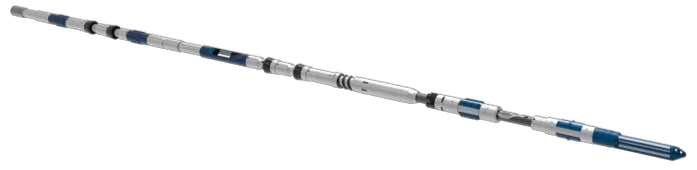
Secondary Completion with Acid Treatment (Matrix Acidizing)
A technology for inflow stimulation in a well after primary reservoir penetration: interval-by-interval acid treatment with isolation of the target intervals by packers.
Advantages
- Selective treatment. In secondary completion (when an additional assembly is run into an existing well), individual reservoir intervals can be isolated with packers. This makes it possible to inject acid only into the required interlayers — for example, treating oil-saturated zones while protecting water-saturated ones from stimulation. As a result, inflow of the target fluid is stimulated in a focused way without provoking a rise in water cut.
- Solving uneven coverage. In reservoirs with heterogeneous permeability, simple acid injection often “locks onto” the most permeable sections, leaving less permeable interlayers untreated. Secondary completion with packers enables interval-by-interval acidizing: each interval is treated separately, which significantly expands reservoir coverage and improves overall efficiency.
- Restoring and increasing permeability. Acid treatment dissolves contaminants in the bottomhole zone (BHZ) — mud residues, filter cake, asphaltene-resin or paraffin deposits, and products of previous operations. In carbonate reservoirs the acid additionally forms channels (“wormholes”) in the rock, increasing permeability and reducing flow resistance on the fluid’s path to the well.
- Extending the well life cycle. The technology is often used not at the construction stage but to “revive” an already producing well whose rate has dropped due to BHZ contamination or uneven inflow. This is more cost-effective than drilling a new well.
- Flexibility in complex conditions. The method has proven itself in horizontal and multilateral wells, where uniformly stimulating a long borehole is especially difficult. It is also relevant for further development of areas with hard-to-recover reserves (HTR).
- Combined-operation capability. Secondary completion with acidizing is often combined with other methods — for example, autonomous inflow control devices (AICDs). This allows a zone not only to be cleaned and stimulated but also to have its inflow profile managed dynamically afterwards, balancing production across intervals.
Specifications
- activation pressure: 5 to 10 MPa
- differential pressure rating: up to 70 MPa
- temperature: 10 to 140 °C
- distance between packers: up to 400 m
- injection rate: up to 5 m³/min
- size range: 60/102; 73/114
Application area and experience
- Carbonate reservoirs. Limestones and dolomites — acidizing is most effective for them, as it relies on dissolving carbonate rock.
- Wells with a contaminated BHZ. After drilling, cementing or perforation, or due to deposits accumulated during operation.
- Reservoirs with heterogeneous permeability. Interlayers with different filtration properties alternate along the section.
- Horizontal and multilateral wells. Where interval-by-interval stimulation of a long borehole is required.
- Mature wells. Where uneven inflow, rising water cut or gas-oil ratio are observed — the technology helps redistribute flows.
- Hard-to-recover reserves. Areas requiring additional inflow stimulation.